
Distilled · 9 episodes on teams and leadership
Your team:
hire better, train well, lose fewer people.
Nine episodes on how a team that stays gets built: onboarding, mentors, standards and retention, distilled for your operation. Every claim links to its minute.
Updated October 1, 2026
In short
- Onboarding is not paperwork: in one example operation it is an hour and a half on day one, plus a mentor assigned per station.1
- The standard holds from day zero: failing to hold it means you failed them, not the other way around.5
- Retention is the number that pays most: every cycle of hiring, training and losing someone costs months of wages in time and productivity.6
- The best recruiting channel is your own staff: their network, with an incentive attached.8
Recruit with what you already have
Russ Hawkins frames it as a channel change: instead of competing on job ads, activate your own people. Your employees have networks and relationships, and if their experience is good, an incentive turns them into a channel with an edge: someone on the inside can tell it like it is.8
Tom Kilby starts further back: before recruiting, set clear expectations and get the team to buy them. Life is pretty simple, he says; after that, you only deal with exceptions.9
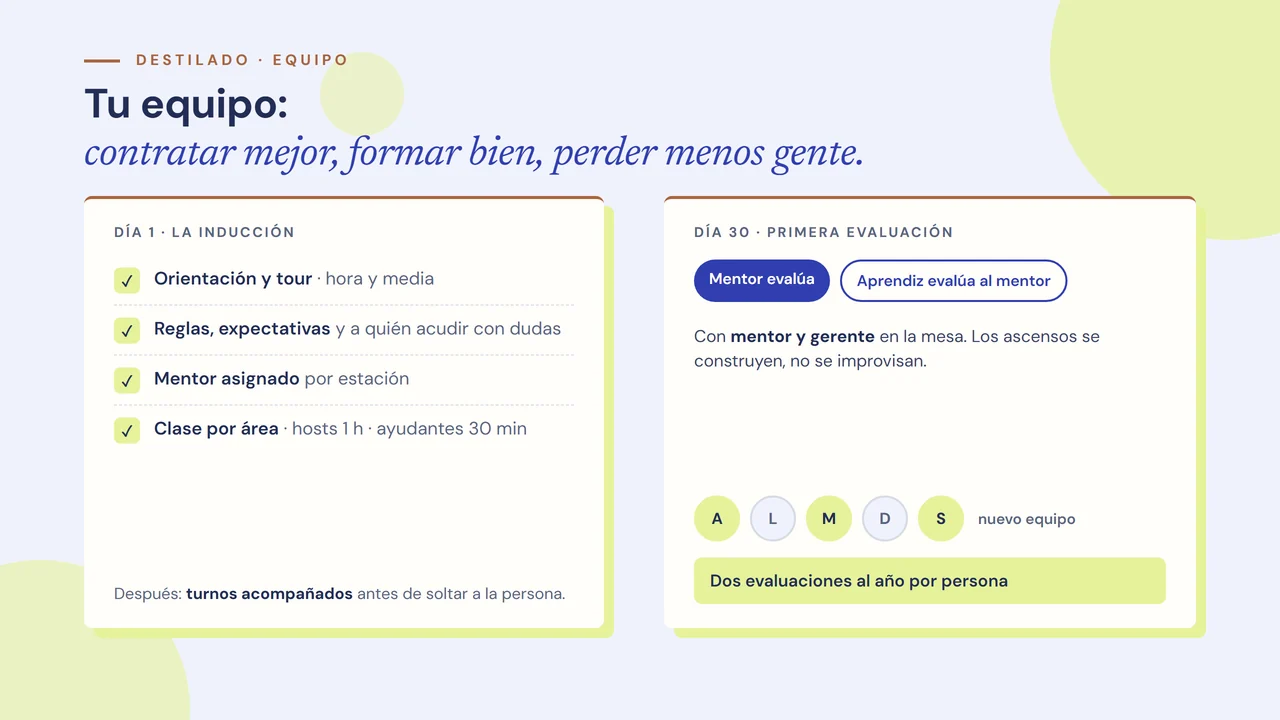
Onboarding: an hour and a half on day one
Andrew Roy, a general manager, describes his process: paperwork and orientation, around an hour and a half on the first day. A tour of the place, what the training will cover, who to go to with questions, and what is expected of the person. After that it depends on the area: hosts take a one-hour class and three accompanied shifts; food runners take half an hour of class before their first shift.1
The mentor who also gets evaluated
Every new hire comes in with an assigned mentor, and the system audits itself: the first evaluation lands at 30 days, with the mentor and a manager at the table. The detail that makes it different: the trainee evaluates the mentor, to see whether the training is working.2
There are two appraisals a year per person, and promotions get built, not improvised.2 Chef Daniel Lugo adds the cross-training: front-of-house managers work every kitchen station and chefs shadow servers, runners and dishwashers. They understand the whole operation, and that is why they run it better.4
The standard holds from day zero
Jason Brooks puts it bluntly: if you are not consistent holding the standard from day zero, not day one, you are the one failing them. They did not fail management, he says; management failed them. Culture, in his version, is what people feel at work: it is fed daily, it cannot be decreed.5
The other side is in Daniel Lugo's operation: every employee owns the situation. His example is a wet floor at a hotel: you do not wait for housekeeping; if you know where the mop is, you solve it.3 With clear rules and job descriptions, and consistent coaching when something drifts.3
Retention: the number that pays most
Steve Kislow, CEO of Firebirds Wood Fired Grill, says it directly: of all the numbers in the business, retention is the most important.6 And he sizes it: in the post-pandemic years, the typical tenure of a new employee was three to four months, and each cycle of hiring, training and losing someone cost 3 to 4 thousand dollars in wages and productivity. His practical recommendation: measure your turnover against the industry's top quartile, not the average.6
Russ Hawkins adds the uncomfortable tool: exit interviews, asking why someone you trained is leaving. And a comparison almost nobody makes: the cost of replacing that person against paying them a little more, giving better benefits and a reason to stay.7
With more people, well led, it gets easier
Abraham runs a group with around 900 people. Counterintuitive: he says it was harder with a single restaurant, because he was human resources, payroll and purchasing at once. Scale brings resources and leverage. His front-of-house training takes five or six days at an established restaurant and up to eight or ten when opening in a new market; managers take weeks or a month. And the phrase that sums up the filter: “you can't teach them how to smile.”10
What is your turnover costing you?
Enter how many people left this year. The rest comes from the episode: each replacement costs 3 to 4 thousand dollars in wages, time and productivity.
Between — and — a year
Every cycle of hiring, training and losing someone costs 3 to 4 thousand dollars, per the episode cited.6 If the number hurts, the lever is retention, not hiring faster.
Your team routine
0 of 7
Frequently asked questions
How do I reduce staff turnover in my restaurant?
First treat it as an indicator: measure it and compare against the top quartile, not the average. Then look at the two moments that weigh most: onboarding with a mentor and the first evaluation at 30 days, and what you pay against what it costs to replace someone already trained.
What does losing an employee cost?
In the episode cited they put it at 3 to 4 thousand dollars per cycle of hiring, training and exit, plus management time. That is why exit interviews and the pay comparison are part of the math.
Where do I start if my team changes every season?
With onboarding: a structured day one, a mentor per station and the 30-day evaluation. It is what the managers in these episodes describe, and the first thing you feel in the operation.
Sources
Our own synthesis by AventarIA from these conversations. The ideas and figures belong to the people who say them in each episode; every link opens the video at the minute cited. Where it says “our reading”, the conclusion is ours.
- Restaurant Rockstars: 440. Improving Restaurant Operations: A General Manager's Guide 27 abr 2025 · min 3:00
- Restaurant Rockstars: 440. Improving Restaurant Operations: A General Manager's Guide 27 abr 2025 · min 6:56
- Restaurant Rockstars: 444. Guide to Restaurant Management Best Practices 25 may 2025 · min 6:12
- Restaurant Rockstars: Struggling with Staff? Chef Daniel Lugo on Fixing Team Dynamics 25 may 2025 · min 4:41
- Restaurant Rockstars: Mastering Leadership in the Food Service Industry with Jason Brooks 16 abr 2024 · min 22:24
- Restaurant Rockstars: Restaurant Leadership Secrets That Build Better Teams & Bigger Profits 24 jul 2026 · min 14:48
- Restaurant Rockstars: 443. How to Reduce Turnover in Restaurants 19 may 2025 · min 13:16
- Restaurant Rockstars: Tired of constant hiring and losing your best restaurant staff? 19 may 2025 · min 8:15
- Restaurant Rockstars: How to Build a Restaurant Team That Stays 3 sep 2026 · min 7:55
- Restaurant Rockstars: Cracking the Hospitality Code: The Journey of Abraham and his Restaurants 8 ene 2024 · min 32:08
Check it with your own numbers.
Send us this month's receipts and your sales report on WhatsApp. In 7 days we tell you, in pesos, how much you are overpaying. If we find nothing, you pay nothing.
Ask for the free diagnosticSee pricing