
Home / Learn / Costs and pricing
Distilled · 9 episodes on costs and pricing
The numbers on your menu:
cost it, price it, watch it.
Nine episodes about a restaurant's numbers, distilled into what you can apply this month. Every claim links to its minute in the original video.
Updated October 1, 2026
In short
- With today's price swings you cannot afford not to know what it costs you to serve every dish.2
- The equation that organizes everything: beginning inventory plus purchases minus ending inventory equals usage; usage over food sales gives you your cost percentage.1
- Prime cost (food, beverage and labor as a share of sales) sits between 50 and 60% in the references of these episodes. Check it weekly.23
- If labor rises three or four points on flat sales, something needs looking at that week.3
Why it is no longer optional
Roger Beaudoin runs Restaurant Rockstars and works with operators every day. His line for the current price moment: “You can't afford not to know what it costs you to serve every single item to every single guest.”2
The mistake he finds most: people know their ingredient prices but not what labor and overhead weigh on top. He calls that a mistake, and it is where his costing class starts.4
The plate, piece by piece
The method is reverse engineering, and it starts at the invoice: your supplier order guides or your invoices give you the cost per unit or per ounce of each ingredient, and from there the cost of each recipe.6
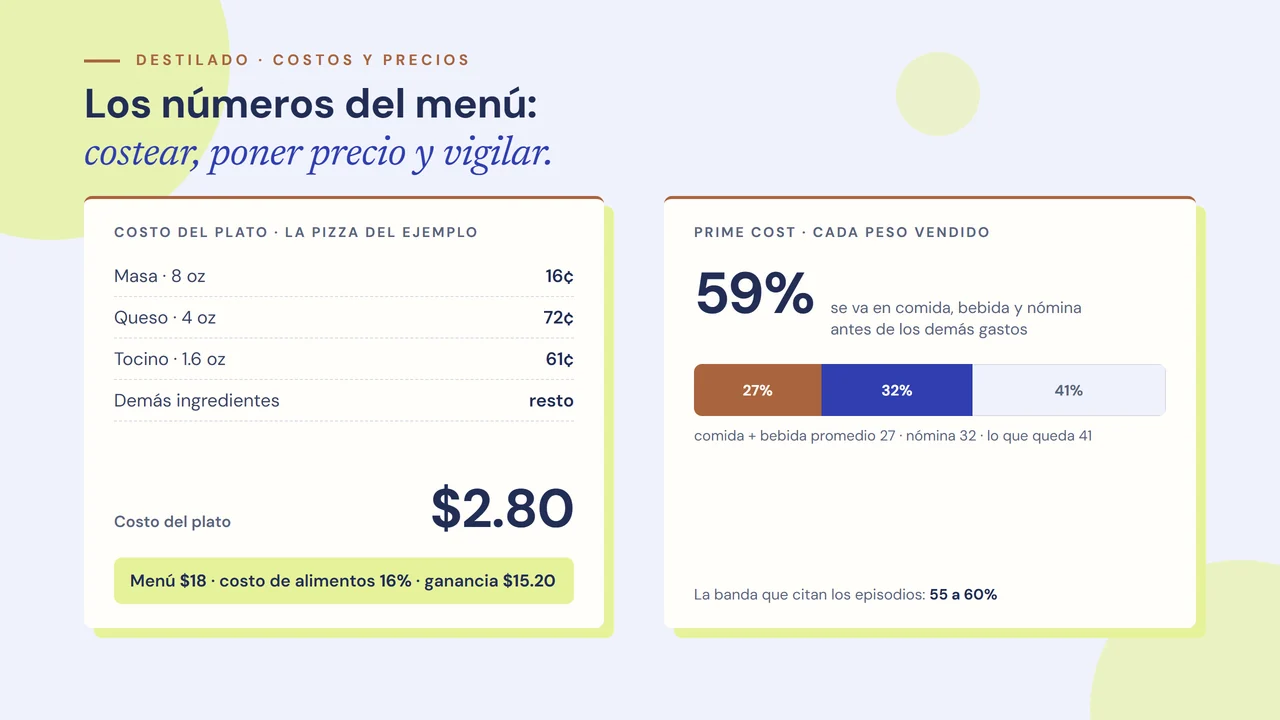
The example broken down, a pizza: eight ounces of dough at two cents an ounce, four ounces of cheese at 18 cents an ounce and 1.6 ounces of bacon at 38 cents an ounce. Add up every ingredient and that total is the plate cost.12
Two details that change the number: the real yield of the product, meaning how much comes out of each purchase, and takeout packaging, which enters the cost when the dish leaves the building.412
The final count of the example: the ingredients added up to $2.80. At an $18 menu price the food cost came out at 16%.5
The inventory equation
This is the formula that organizes everything, and it comes from accounting, not the kitchen: beginning inventory plus purchases minus ending inventory equals usage. Usage divided by food sales for the period gives you your cost percentage.1
The detail that distorts the numbers: last month's leftover. Fred Langley, CEO of Restaurant Systems Pro, explains it with a five-gallon container: if that product is still on your shelf and you do not count it, your usage looks inflated, as if you had used it without selling it.8
The fine version connects recipes to the point of sale: every recipe tied to a button. If you sold ten soups, the system knows how much raw material you should have used and compares it against what left the storeroom.9
Prime cost: the number that decides
Food plus beverage plus labor, all as a percentage of sales. That is prime cost and, in Roger's words, it “determines whether or not you're making money in your restaurant.”1
His example: 32% food cost plus 22% beverage cost makes 54%. Averaged, that is 27%. Add 32% labor and prime cost lands at 59%.7
What it means: out of every dollar sold, about half goes there before rent, insurance, utilities and maintenance. That is why he reviews it weekly, not quarterly.2
Yorgo, an operator with decades in large chains, puts it just as bluntly: the two main costs take “sometimes 50, 52, 55, 56, 60% of what you bring in,” and labor accelerated by double digits in about two years.11
Another use of the same number: compare sales volume against the profit of each dish, category by category. His benchmark: expensive items should sit within a dollar of profit of each other, and cheap ones within 50 cents. That way it does not matter which one sells more.10
Where they disagree: the exact number
In April 2025 Roger put the healthy range at 55 to 60%.2 In March 2026, in another episode of the same show, he put it at 50 to 55%.3 Both numbers come from someone who sees hundreds of restaurants: treat them as a band you watch weekly against your own history, not as a law.
What is your prime cost?
The three numbers come from this month's books. As in the episode's example: food 32%, beverage 22% and labor 32%.
Food and beverage average 27% · Prime cost: 59%
Inside the band the episodes cite (55 to 60%).
The starting example is the one Roger uses in the episode.7 The 55 to 60% band comes from the reference cited above.2
The whole case, live
To see all of this applied end to end we built a single-location demo pizzeria: the standard cost of its medium pepperoni, week-by-week leakage, menu engineering and a price experiment, with the math in the open. The same logic as this article, over a full menu.
Public case: Forno Demo, a single-location pizzeria (fictional brand, reusable template).
Your costing routine
0 of 6
Frequently asked questions
What is prime cost and what is a good number?
The sum of food, beverage and labor as a percentage of your sales. In the episodes cited the reference sits between 50 and 60%; the lower it is, the more margin is left for everything else.
How often should I cost my menu?
Your best sellers, continuously: with price swings you can lose margin in weeks. Run the full menu by season or when a key ingredient moves.
Do I need special software to cost a menu?
No. The episodes say it themselves: it is simple math, with a pencil and a calculator, and your invoices as the starting point. What does not forgive is not doing it.
Sources
Our own synthesis by AventarIA from these conversations. The ideas and figures belong to the people who say them in each episode; every link opens the video at the minute cited. Where it says “our reading”, the conclusion is ours.
- Restaurant Rockstars: 439. Maximizing Menu Profit Through Effective Design and Strategy 22 abr 2025 · min 11:18
- Restaurant Rockstars: 439. Maximizing Menu Profit Through Effective Design and Strategy 22 abr 2025 · min 12:50
- Restaurant Rockstars: The 5 Biggest Restaurant Mistakes Destroying Profit Margins Right Now 12 mar 2026 · min 5:26
- Restaurant Rockstars: The 5 Biggest Restaurant Mistakes Destroying Profit Margins Right Now 12 mar 2026 · min 9:35
- Restaurant Rockstars: Restaurant Profit Maximizer: Free 1-Hour Masterclass 12 sep 2026 · min 56:49
- Restaurant Rockstars: Episode #320 Restaurant Profit: How to Move the Needle 25 nov 2022 · min 9:33
- Restaurant Rockstars: Mistakes Most Restaurants Are Making!!! And How To Fix Them! 28 mar 2025 · min 46:57
- Restaurant Unstoppable: Restaurant Systems Pro Recipe Costing Systems 10 jun 2024 · min 8:02
- Restaurant Unstoppable: Restaurant Systems Pro Recipe Costing Systems 10 jun 2024 · min 1:18
- Restaurant Rockstars: STOP Losing Money: Your Restaurant's Prime Cost & Labor FIX 23 nov 2025 · min 11:19
- Restaurant Rockstars: How to Grow Restaurant Profit, Teams & Leadership 15 dic 2024 · min 35:02
- Restaurant Rockstars: Episode #340 How to Maximize Restaurant Profit 29 abr 2023 · min 61:27
Check it with your own numbers.
Send us this month's receipts and your sales report on WhatsApp. In 7 days we tell you, in pesos, how much you are overpaying. If we find nothing, you pay nothing.
Ask for the free diagnosticSee pricing